|
Guyana
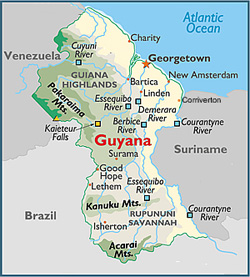 Guyana
is a tropical country situated on the northern coast of South
America. It is the only country in South America where English is
the official language. It is bordered by Venezuela on the west,
Suriname on the east, Brazil on the south and the Atlantic Ocean on
the north. Guyana
is a tropical country situated on the northern coast of South
America. It is the only country in South America where English is
the official language. It is bordered by Venezuela on the west,
Suriname on the east, Brazil on the south and the Atlantic Ocean on
the north.
Guyana has an area of 214,969 square
kilometers (83,000 sq mi), about the size of Great Britain. The name
Guyana is an Amerindian word meaning Land Of Many Waters. Guyana is
known as the country of Six People - Africans, Amerindians, Chinese,
East Indians, Europeans and Portuguese.
It is where the virgin rainforest leads
to the Amazon Basin, where the jungle is still unexplored, rivers
uncharted and mountains unclimbed. With over 300 waterfalls,
including one of the World's longest Single drop falls, the stunning
Kaieteur at over 700 feet, over 800 species of birds and a wide and
unique array of fragrant flora and magnificent fauna, it is an
incredibly wonderful land of unspoiled beauty.
This is a land famous for acclaimed
poets Martin Carter and A.J. Seymour, internationally acclaimed
singer and songwriter Eddie Grant, famous Jazz legend Art Booms,
amazing cricketer Clive Lloyd and many others. It is the land where
Sir Walter Raleigh searched for El Dorado and Sir Arthur Conan Doyle
was inspired to write his classic, The Lost World.
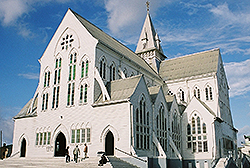 Georgetown
is the chief port and capital of Guyana. It is situated on the right
bank of the Demerara River estuary. In Georgetown, familiar
landmarks include the lively Stabroek Market, the sea-wall and the
Anglican cathedral of St George, the tallest wooden building in the
world. Georgetown
is the chief port and capital of Guyana. It is situated on the right
bank of the Demerara River estuary. In Georgetown, familiar
landmarks include the lively Stabroek Market, the sea-wall and the
Anglican cathedral of St George, the tallest wooden building in the
world.
|